%20-%20250x450.png?width=250&height=450&name=IIP%20Logo%20-%20Portrait%20(Purple)%20-%20250x450.png)
Tradecraft


In June 2026, IIP Director David Hopkins presented at the International Association for Intelligence Education's Annual Global Conference at the University of North Georgia. His paper, co-authored with IPIA founding contributor Anthony Allen, Intelligence and Intelligence Training as an Enabling Function for Information Operations in Multi-Sector, Multi-Domain Contexts, argues that intelligence methodology is the missing architecture in modern information operations and sets out a practical framework for closing the gap. The full paper is published below.
Authors: David Hopkins, Institute for Intelligence Professionalisation (IIP) and Anthony Allen, Information Power Institute Australia (IPIA)
Conference: IAFIE Annual Global Conference, University of North Georgia, Dahlonega, Georgia, USA
Dates: 1-3 June 2026
Panel: Nexus of Cyber and AI in Warfare and National Security
AI is reshaping the information domain by scaling and accelerating both offensive and defensive efforts. These developments compress decision cycles and increase risks of misattribution and escalation. Foreign influence campaigns increasingly fuse cyber-enabled access, data theft and leaks, and AI-assisted narrative production, blurring technical compromise with effects on perception, trust, and behaviour at a scale and pace not seen before. This paper advances three propositions: (a) Intelligence is indispensable to information operations, but not their sole contributor. (b) Professionalisation using intelligence principles is critical. (c) A whole-of-government and whole-of-society model spanning government, industry, and academia, integrating strategy and policy alignment, operational design and targeting, engagement, technical execution, governance and intelligence-driven assessment, is required. Drawing on contemporary case studies of rapid innovation, narrative contestation, and cyber operations, the paper supports a framework for coordination, resilience, and the measurement of effects. It proposes a practical multi-classification intelligence training roadmap to enable AI-assisted sensing, analysis, and dissemination, whilst evaluating feasibility and risks. It explores the formation of an AI and Information Domain Collaboration to develop a governance and management system as a potential response to a highly charged information environment.
In 2009, Australian Special Forces in Afghanistan had access to something that felt like omniscience. A Heron unmanned aerial system was providing real-time full-motion video directly to the command centre. Commanders could watch events unfold in near real time from altitude with a clarity unimaginable a decade earlier. And yet, the picture was not producing better decisions.
Watching the live feed felt like understanding the situation. It was not. Intelligence value is not derived from a single sensor feed, however detailed or continuous it may be. It comes from correlating multiple sources, applying structured analytical tradecraft, and producing an assessment that answers the questions a decision-maker actually needs answered: why this is happening, what comes next, and what we should do about it. The feed showed what was happening. Intelligence would have answered why it was happening, who was involved and what was likely to happen next.
This gap between data and decision advantage, the capacity to observe without the analytical architecture to act, is not confined to the battlefield. It is the defining problem of the modern information environment. Governments, defence organisations, and industry are investing heavily in AI-enabled platforms, data collection capabilities, and information operations tools. Investment in sensing and collection is accelerating, while the intelligence methodology required to turn that data into decisions is not keeping pace.
The shift in the nature of decision advantage is fundamental. Before the information age, advantage came from controlling and constraining information; today, advantage comes from sensing and understanding within an environment flooded with data, with intelligence functions central to both the cultural understanding of audiences and the analytical capacity to verify facts.
Intelligence methodology and application are the missing layer. Without it, organisations invest in capability that generates activity rather than effects, collect data that cannot enable decision advantage, and support operations they have no way to measure or account for. The gap between capability and decision advantage in the information environment is a training and methodology problem, not a technology problem. Three propositions follow from this argument, each addressing a different dimension of the same gap:
The remainder of the paper develops each proposition in turn, supported by case studies, before setting out the coordination framework and training pathway that translate the propositions into operational practice.
The information environment is the aggregate of individuals, organisations, and systems that collect, process, disseminate, or act on information. It encompasses three dimensions:
These dimensions cannot be separated in practice. A cyberattack on communications infrastructure is also an act of cognitive disruption, designed to erode confidence and sow confusion among the target population. A narrative campaign is also an informational and technical operation that requires the collection, analysis, production, and dissemination of information. Operations that treat these dimensions as separate problems, handled by separate people in separate organisations, consistently fail to achieve integrated effects. This framework, drawn from the Information Power Institute Australia's information power model, provides the conceptual foundation for the paper's argument.[1]
Figure 1 represents this framework as three overlapping dimensions, with operations in the information environment occupying the spaces where the dimensions intersect. The most consequential operations, including the case studies that follow, sit at the centre where all three meet.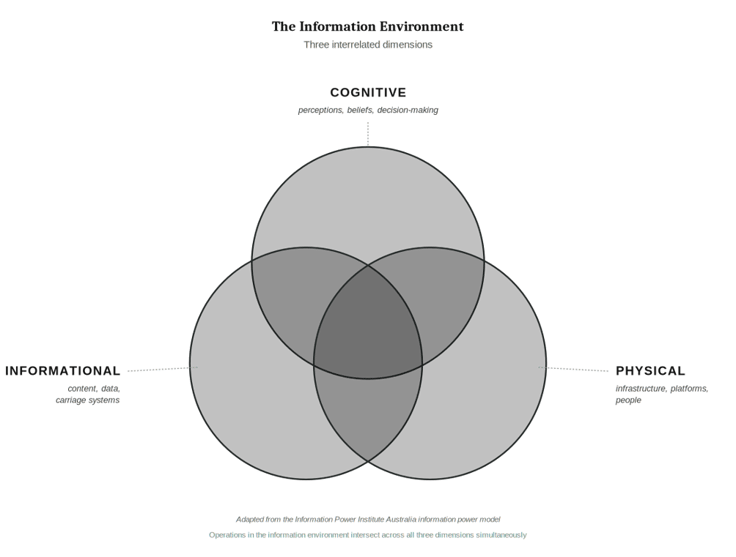
A Situation Report
AI has industrialised narrative production. The volume, velocity, and personalisation of influence operations are no longer constrained by human capacity for content creation. Adversaries can now generate, test, and distribute targeted narratives at a scale that overwhelms manual detection and response capabilities.[2]
Foreign influence campaigns increasingly fuse cyber-enabled access with narrative operations.[3] Intrusion, data theft, and targeted leaks are not preparatory steps that are later followed by information operations. They are integrated effects, designed to achieve technical compromise and cognitive impact simultaneously. The Operation Ghostwriter campaign, which has been running since 2017 and targets NATO's eastern flank, is a documented example of this fusion in practice.
Decision cycles for detection, attribution, and response have compressed to hours and minutes.[4] The lag between a technical compromise and its cognitive effect on a target population can now be measured in hours rather than weeks. Institutions designed to respond to these threats operate on timelines that no longer match the environment they are defending.
This compression is not accidental. Adversaries deliberately design operations to exploit the gap between the speed of effect and the speed of response, injecting fabricated content, false flags[5], and manufactured provenance to ensure that defenders are not just acting on an incomplete picture but a false one. Misattribution is the intended effect, resulting in defenders countering the wrong narrative, targeting the wrong actor, or responding to the wrong threat. In a compressed decision cycle, that error can be irreversible.
Case Study: Ukraine 2022 to present
The Russian invasion of Ukraine produced the most extensively documented example of integrated cyber and information operations in the open-source record. Russia's objectives were to control the opening narrative, fracture Western unity, and suppress Ukrainian resistance by creating the impression of inevitable defeat. The Viasat satellite network attack in the opening hours degraded Ukrainian command and communications, while a series of pre-planned false flag narratives sought to attribute the initiation of conflict to Ukraine and its Western backers.[6] Had those narratives taken hold, governments uncertain about who started the conflict would have been far slower to coordinate support for Ukraine.
The Allied response countered this directly. By making intelligence about Russian military movements public before the invasion, allied governments pre-empted the false flag narratives and ensured the international community had a verified picture of Russian intent before the first shot was fired.[7] Russia's narrative framing failed in the opening hours because the conditions for misattribution had been denied.
Case Study: Operation Ghostwriter 2017 to present
Operation Ghostwriter has targeted Poland, Lithuania, and Latvia over a sustained period since 2017. Initial public attribution by Germany and the European Union pointed to Russian military intelligence, though subsequent technical analysis by Mandiant has linked the campaign more directly to Belarusian operators, with likely Russian collaboration.[8] The campaign's purpose was to erode public trust in NATO and destabilise the alliance's eastern flank by making it appear that NATO officials and member state governments were themselves questioning the alliance's value and integrity. Misattribution was both the mechanism and the strategic objective.
To achieve this, the operation compromised government websites and email accounts to plant fabricated content, including forged military communiques, invented policy statements, and fake correspondence attributed to real officials. This was deliberate disinformation[9] designed to produce misattribution at scale. Citizens, journalists, and policymakers had no reason to doubt the content's provenance. The source appeared legitimate because it had been compromised. The adversary's narrative was amplified as if it were the authentic voice of NATO member institutions.
The operation ran largely unchallenged for several years before attribution, demonstrating precisely what happens when intelligence collection and analysis against this kind of hybrid operation is absent. The narrative effect accumulates while the defender remains unaware of who is producing it or why.
The first proposition is more precise than the claim that intelligence is important. The argument is that intelligence is what makes information operations coherent and accountable. Without it, the other components of information operations - communications, technology, policy, and operational execution - function in isolation, producing activity that cannot be measured, targeted, or controlled.
Three functions that only intelligence provides in information operations are worth examining in detail. The first is target audience analysis[10], identifying the right audiences, narratives, and moments for effect. Without it, information operations produce content for undifferentiated audiences and hope for impact. The second is an effects assessment that determines whether an operation achieved its intended cognitive, informational, or physical effect, or produced unintended consequences requiring adjustment. The third is warning: detecting when an adversary will achieve, or has achieved, a cognitive effect before decision-makers have recognised it, providing the lead time required for a coordinated response.
This is particularly significant in democracies, where adversary information operations target not only government decision-makers but the populations whose votes determine who those decision-makers are. The cognitive effects on a population today shape the political authority of decision-makers tomorrow, making population-level warning a strategic intelligence requirement, not just a tactical one.
Some information operations practitioners argue that in the AI-accelerated environment, speed matters more than precision and that intelligence processes are too slow. In some circles, this argument has merit. If an adversary can generate and distribute a narrative in minutes, a multi-day assessment cycle is not a response.
The counter is straightforward. Speed without correct attribution can produce friendly fire in the information domain. Countering the wrong narrative amplifies the original by repeating its framing, and targeting the wrong actor creates escalation where de-escalation was achievable. The case study on Ukraine demonstrates the alternative. Intelligence-driven pre-emption denied the adversary its intended narrative space before the operation began, faster than any reactive response could have achieved.
It is essential that decision-makers have a complete and verified picture before they act. Information warfare doctrine developed within the Australian Defence Force[11] reflects the same principle. Doctrine provides the governance and strategic framework that information operations require, and it must be informed by intelligence practice.
Case Study: Ukraine - Intelligence as the Main Effort
The deliberate public disclosure of US and allied intelligence about Russian military movements in the weeks before the February 2022 invasion was a novel use of intelligence as an information operations instrument. By making the intelligence public, the US and allied governments pre-empted the false flag narratives Russia had prepared to justify the invasion and denied Russia the ability to control the opening narrative of the conflict. Intelligence was not supporting the operation; it was the operation. The effects were measurable and significant. Russia's narrative framing failed in the opening hours of the conflict, and the international response was shaped by the allied intelligence picture rather than by Russian information management.
Operating in the information environment without intelligence principles produces inevitable failure modes. Confirmation bias shapes analysis and targeting toward conclusions the practitioner already holds. Poor source validation amplifies nefarious narratives, turning defensive operations into force multipliers for the adversary. Effects assessment measures activity rather than impact. Post counts, reach, and engagement metrics say nothing about whether a cognitive effect was achieved or about its second-order consequences. Perhaps most critically, practitioners without intelligence training cannot reliably distinguish between influence and manipulation, in either direction, leaving them unable to assess whether their own operations are operating within the ethical and legal boundaries their organisations require.
These practitioners are present across government, defence, and industry. The roles span military operations and information warfare planners, policy officers in foreign affairs, home affairs, and national security agencies, departments responsible for public communication during emergencies, natural resource management, public health, and essential services, and corporate communications, security, and risk professionals across sectors from finance to mining to critical infrastructure.
Professionalisation means more than training. It requires a shared professional identity, common standards, and an ethical framework that travels across sectors. Without a common professional language, coordination breaks down at the practitioner level even when the organisational structures for cooperation are in place. The intelligence community itself has sometimes been part of the problem, siloed, classification-bound, and slow to share with non-government partners. Professionalisation must go both ways, outward to the broader information operations ecosystem and inward in the form of greater openness to cross-sector collaboration.
The Institute for Intelligence Professionalisation (IIP) is developing an intelligence training framework that will establish a nationally recognised qualification[12], creating portable intelligence literacy across sectors. This work builds on an intelligence training continuum developed for Australia's Defence intelligence workforce, which demonstrated that structured professional development in intelligence practice is effective at scale and applicable across diverse operational contexts.
IIP's professionalisation framework explicitly includes AI literacy as a core competency. Intelligence practitioners operating in the modern environment must understand how AI tools work, where they can introduce bias or error, how AI-generated content differs from human-produced analysis, and how to work with AI as a capability rather than defer to it as an authority. Practitioners who cannot critically evaluate AI-generated content, recognise its limitations, or integrate it appropriately into the analytical process are becoming a liability in the information environment rather than an asset.
Case Study: Internet Research Agency / United States 2016
The Internet Research Agency was a Russian state-linked organisation[13] that conducted a sustained influence operation targeting the 2016 US presidential election, using fake social media accounts, fabricated personas, and algorithmically amplified content to inflame social divisions, suppress voter turnout in targeted demographics, and undermine confidence in democratic institutions.
The US Senate Intelligence Committee's reporting provides granular detail on the operation's scope, methodology, and effects.[14] The failure modes on the defensive side are equally instructive. Attribution was slow, coordination between government agencies and technology platforms was poor, and effects assessment was essentially absent until years after the fact. These are professionalisation failures as much as resource failures. People working in the defensive information space without intelligence principles produced a confused, activity-measured response that failed to limit the operation's cognitive impact.
The preceding propositions establish what intelligence contributes to information operations and why professionalisation is the mechanism for building that capability at scale. But trained practitioners do not operate in a vacuum. The case studies in this paper have focused on state-based adversaries, and for good reason. Russia, China, Iran, and North Korea represent the most sophisticated and sustained threats in the information domain. They are not the only ones. Criminal syndicates use information operations to facilitate fraud and undermine law enforcement. Ideologically driven groups exploit the same AI-enabled tools to radicalise and recruit. Disinformation-for-hire networks sell influence operations commercially. The response must be as broad as the threat, requiring a structural model that brings government, industry, and academia into coordinated action, with intelligence principles embedded throughout.
No single sector can solve the information domain problem alone. The barriers to building that model are substantial. The government has authority and legal access, but limited agility and deep institutional resistance to working with private sector partners outside formal contracting arrangements. Industry has technology and speed, but operates without formal responsibility for national security unless under contract to the government. Adversaries of all kinds deliberately exploit this accountability gap. State actors, criminal syndicates, and ideologically driven groups all operate across the private sector at scale precisely because industry lacks the legal authority, mandate, and obligation to respond. Academia brings analytical depth and research capability but operates on timelines and incentive structures that rarely align with operational urgency. Civil society has reach and legitimacy that government and industry cannot replicate, particularly in building community resilience to influence operations, but has almost no infrastructure for coordinated action.
The coordination problem runs deeper than organisational structure. A government analyst, an industry threat intelligence practitioner, and an academic researcher may all be independently tracking the same adversary operation, with no mechanism to share what they know, compare their assessments, or coordinate a response. The barrier is structural, and the systems for cross-sector intelligence sharing simply do not exist at the scale the threat demands.
Two case studies illustrate what this looks like in practice.
Case Study: Taiwan's Cognitive Resilience Model
Taiwan's whole-of-society response to information operations is among the most studied and documented of any democracy, and for good reason. It operates across four distinct layers:
Together, these layers constitute a functioning model. Survey data show Taiwanese citizens are among the most resistant to foreign influence operations of any population studied, a product of sustained political will, significant public investment, and direct lived experience of the threat.
Case Study: Estonia Post-2007
In 2007, Estonia became the target of a coordinated series of distributed denial-of-service attacks that overwhelmed government ministries, banks, media outlets, and communications infrastructure, taking large parts of the country's digital public sphere offline for several weeks. The trigger was the Estonian government's decision to relocate a Soviet-era war memorial, the Bronze Soldier statue, from central Tallinn to a military cemetery. Russia framed the relocation as an act of desecration and combined the cyberattacks with a sustained narrative campaign designed to delegitimise the Estonian government and inflame ethnic Russian sentiment domestically and internationally.[19]
Estonia's response was systematic and formative. The government worked with internet service providers to filter malicious traffic, maintained public communications throughout the crisis to deny the narrative vacuum the attacks were designed to create, and treated the event as a national security incident requiring a whole-of-government response. The direct outcomes were the establishment of the NATO Cooperative Cyber Defence Centre of Excellence in Tallinn in 2008 and the embedding of cyber resilience in national defence doctrine as a core national security requirement.[20]
The response succeeded not because it stopped the attacks, which had run their course, but because it turned a damaging incident into the foundation for a substantially more resilient national and alliance posture. The prerequisite was political will.
Figure 2 plots the six case studies in this paper across the three dimensions of the information environment. The distribution illustrates a pattern central to the paper's argument: the most consequential operations sit at the intersections, where intelligence-driven coordination across cognitive, informational, and physical dimensions is required to understand and counter them.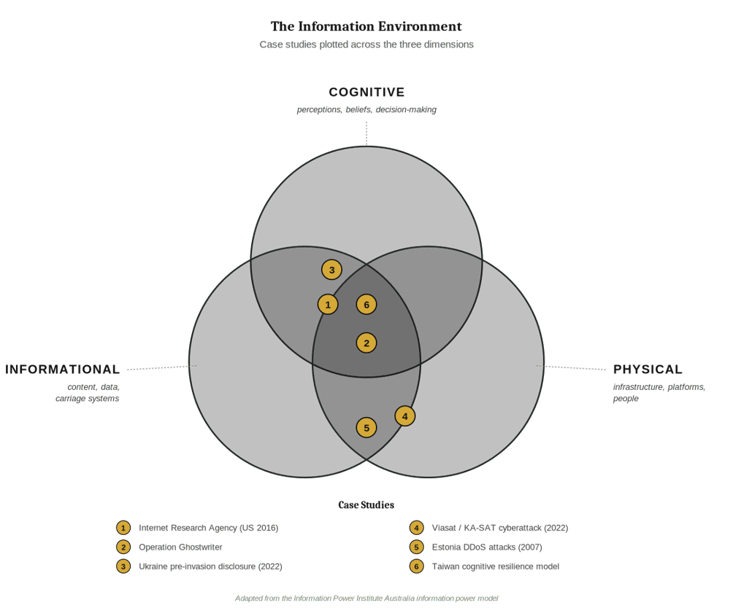
Australia, and many of our partners, do not yet have an equivalent integrated model. Capability exists across government agencies, industry, and academia, but without the common standards, shared methodology, and cross-sector coordination infrastructure that Taiwan and Estonia demonstrate is achievable. Australia's foreign interference legislative framework,[21] Australian National Security threat assessments,[22] and critical infrastructure initiatives[23] are important foundations, but they do not yet constitute a coherent whole-of-society response. That gap prompted three Australian organisations to establish a formal collaboration.
The AI and Information Domain Collaboration brings together Australian Industry - Elysium EPL, the Information Power Institute Australia, and the Institute for Intelligence Professionalisation with a shared purpose of developing a centre of excellence, in collaboration with a university partner, that integrates government, defence, industry, and academia to build Australia's capability and resilience in the information domain. The collaboration brings together four distinct contributions:
The collaboration's core activities span governance development, training pathway design and validation, collaborative research and experimentation, and building the cross-sector professional network that whole-of-society information resilience requires.
The model has direct applicability beyond Australia. Partner nations facing the same threat environment and the same structural gap can adapt it to their own contexts, and the IAFIE community is the right forum to begin that conversation.
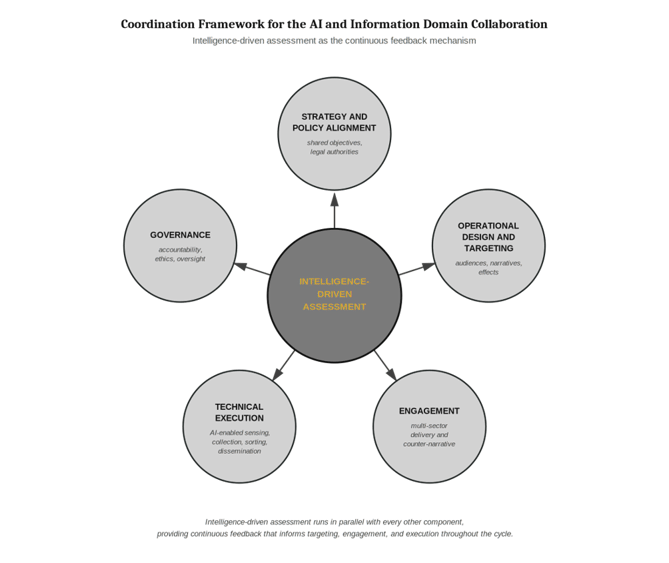
The collaboration's work is organised around a coordination framework that translates the three propositions into an operational model. Six components are required, and their relationships to each other matter as much as their individual designs.
Figure 3 presents this framework visually, with intelligence-driven assessment at the centre and the other five components arranged around it. The arrows from the centre indicate the continuous feedback flow that intelligence provides to each of the other components throughout the operational cycle.
The most significant training gap in the information domain is among practitioners conducting information operations who have never received intelligence training, rather than within the intelligence community itself.
AI deployed without intelligence principles creates three predictable problems. It produces confident outputs without established provenance, increasing the risk of misattribution. It cannot distinguish between situations that require escalation and those where de-escalation is achievable. And it produces effects that cannot be measured because there is no underlying assessment framework. The case studies in this paper document each of these failure modes.
Building the analytical discipline required to avoid these failure modes is the purpose of the training pathway that the collaboration is developing.
The training response requires two layers. The foundation layer is IIP's nationally accredited intelligence skills training framework, which builds intelligence literacy, common methodology, and portable qualifications across the workforce. This layer establishes the professional baseline that makes the specialist layer possible and is referenced here rather than detailed.
The specialist layer is a purpose-designed training pathway for information operations practitioners, built on the intelligence foundation and extended to encompass the specific competencies required to operate in the AI-enabled information environment, including:
The specialist pathway must operate across classification levels. Information operations practitioners in government work with classified material that their industry and academic partners cannot always access. The training roadmap is designed to create a common professional language and methodology that functions at each classification level, enabling coordinated action without requiring full information sharing. Practitioners trained to this standard can operate effectively in their own classification environment while maintaining the professional interoperability required for cross-sector coordination.
This design is informed directly by operational experience integrating classified capabilities into multi-agency, multi-national environments, where the challenge of maintaining coordinated action across classification boundaries is a practical problem solved through training, methodology, and professional standards rather than by lowering classification barriers.
The convergence of AI, cyber operations, and narrative production has already reshaped the information domain. The institutions, doctrines, and training systems designed to operate in it are still catching up. The case studies in this paper document what happens when that gap is not closed. Operations run unchallenged for years, defensive responses amplify the threats they are trying to counter, and the cognitive effects of adversary campaigns accumulate without measurement or accountability.
The answer is not more technology. Better AI tools in the hands of practitioners without intelligence principles produce better-scaled versions of the same failure modes. The collaboration exists to close that gap by building the training and professionalisation infrastructure that embeds intelligence methodology in how practitioners think, plan, target, assess, and adapt.
The educators, researchers, and practitioners engaged through the IAFIE community are shaping the next generation of intelligence and national security capability. This paper has argued that intelligence principles must be embedded in the training of information operations practitioners, that professionalisation is the mechanism for doing so, and that no single sector can build the required capability alone. The collaboration is making that investment now. The invitation to contribute is open to institutions and organisations across the international intelligence and national security community.
This paper was developed with AI assistance for research, structuring, and editing for clarity. All ideas, arguments, and conclusions are those of the authors. Final responsibility rests with the Institute for Intelligence Professionalisation in accordance with IIP's AI Use Policy.
David Hopkins is Director and Head of Learning at the Institute for Intelligence Professionalisation (IIP), where he is leading the design of an accredited intelligence training continuum defining what professional intelligence support looks like at a national qualification level in Australia. He is also the Director and Co-Founder of Fire Hawk Services, which builds decision-making capability for organisations in Defence, emergency services, and public safety aviation. A retired RAAF Intelligence Officer with over twenty-five years of service, his career included deploying unmanned aerial systems with Australian Special Forces, strategic all-source analysis at the Defence Intelligence Organisation, and leading the team that developed the contemporary training continuum for Defence's intelligence workforce. His current work sits at the intersection of intelligence professionalisation, operational decision-making, and learning design for complex, high-stakes environments.
Anthony Allen is a Director at Elysium EPL and a founding contributor to the Information Power Institute Australia (IPIA), with more than twenty-five years of experience in program management, research, analysis, and operational design across Defence, other government agencies and industry. A former Naval Officer qualified in advanced naval intelligence and joint cyber warfare, he researched, wrote, and delivered the Navy Information Warfare Branch Electronic Warfare and Information Effects Capability Needs Statement, drawing on operational experience gained during deployments to the Middle East, Afghanistan, and the Indo-Pacific. Anthony also co-designed the Information Warfare Governance and Management System for the ADF Joint Capability Group. He has advised Commonwealth and state governments, and international clients on planning and delivery, and holds qualifications spanning intelligence, cyber warfare, and training and assessment. His current work sits at the intersection of information power, governance, and capability development for complex operational environments.
[1] Information Power Institute Australia (n.d.).
[2] The shift from manually-produced to AI-enabled influence content is documented in industry and academic analysis, including the OpenAI and Stanford Internet Observatory joint study on generative language models in influence operations (Goldstein et al., 2023). The World Economic Forum's 2025 Global Risks Report identifies AI-amplified misinformation and disinformation as the top global risk.
[3] The integration of cyber-enabled access and narrative operations is documented in CrowdStrike's annual threat reporting, which identifies nation-state actors using generative AI alongside cyber operations to amplify divisive content and disinformation campaigns (CrowdStrike, 2024).
[4] The deliberate compression of defender decision cycles through cyber and influence operations is documented in the academic and policy literature, including INSS analysis identifying the slowing of decision cycles as a primary objective of cyber influence operations (Tayouri, 2020).
[5] A false flag is a covert operation designed to deceive observers into believing it was carried out by a party other than the one actually responsible. The term originates from naval warfare, where ships would fly the flag of an enemy or neutral nation to disguise their identity. In the context of information operations, false flag tactics involve fabricating evidence of origin, authorship, or intent to mislead defenders about who is conducting an operation and why, deliberately engineering misattribution as a strategic outcome.
[6] The cyberattack on Viasat's KA-SAT network occurred approximately one hour before Russian forces crossed the border on 24 February 2022 and was publicly attributed to the Russian Federation by the EU, US, UK, and Five Eyes governments on 10 May 2022 (Council of the European Union, 2022; UK National Cyber Security Centre, 2022).
[7] From January 2022, the United States and United Kingdom released declassified intelligence assessments warning of Russian troop movements, false flag preparations, and plans to install a pro-Russian government in Kyiv. The deliberate pre-emption strategy is documented in Senate Intelligence Committee Chairman Mark Warner's public statements at the time and in subsequent academic analysis (Dover and Goodman, 2024)
[8] German Federal Foreign Office attributed Ghostwriter activity to the Russian GRU, Russia's military intelligence agency, on 6 September 2021, and the EU High Representative issued a corresponding declaration on 24 September 2021 (Council of the European Union, 2021). Mandiant subsequently assessed in November 2021 that the technical operator UNC1151 was based in Minsk and likely operating on behalf of the Belarusian government, while not ruling out Russian involvement (Mandiant, 2021).
[9] Disinformation is false information deliberately created to mislead, distinct from misinformation, which is false information shared without intent to deceive. The distinction matters because it identifies adversary intent as the operative variable, not the falsehood itself.
[10] The institutional home for target audience analysis varies. The US and UK view it as primarily a PsyOps function, while other doctrines treat it as an intelligence function. Regardless of institutional home, the methodology required is intelligence methodology, which is the argument advanced here.
[11] The development of ADF information warfare doctrine is documented in publicly available analysis by Morgan and Thompson (2018), produced through the Center for Strategic and International Studies. Major General Thompson was the inaugural Head of Information Warfare for the ADF.
[12] Australia's vocational education and training framework operates through nationally recognised qualifications accredited by the Australian Skills Quality Authority (ASQA), with qualifications structured at progressive levels under the Australian Qualifications Framework. Certificate III and IV qualifications sit at the practitioner skill levels of this framework. IIP's training continuum is being developed for delivery under this national framework (Institute for Intelligence Professionalisation, n.d.).
[13] The Internet Research Agency was based in St. Petersburg and operated under the direction of the Kremlin.
[14] The operation's scope, methodology, and effects are documented in the US Senate Select Committee on Intelligence's bipartisan five-volume report, with Volume 2 specifically addressing Russia's use of social media (US Senate Select Committee on Intelligence, 2019; 2020).
[15] The government's rapid rebuttal system operates on a '2-2-2' principle, requiring rebuttal within two hours using 200 words and two images (Gateway House, 2024).
[16] The g0v (pronounced ‘gov-zero’) civic technology community, founded in 2012, has spawned organisations including Cofacts, Doublethink Lab, and the Taiwan FactCheck Center (The Diplomat, 2024).
[17] Media literacy is embedded in the national curriculum through the Ministry of Education's 2002 Media Literacy Education White Paper, updated in 2023 as the Digital Era Media Literacy Education White Paper, and integrated into the 108 Curriculum Guidelines as one of nine core values (Ministry of Education, Taiwan, 2002; 2023).
[18] Civil defence planning is now coordinated through the Whole-of-Society Defense Resilience Committee, established in 2024, with five priority areas including civilian force training, critical infrastructure protection, and information network protection (Brookings Institution, 2025)
[19] Attribution of the 2007 attacks remained formally contested, although the majority of malicious traffic was of Russian-language origin and accompanied by hostile political rhetoric from Russian officials and refusal to cooperate with Estonian investigation requests (NATO StratCom Centre of Excellence, 2019).
[20] The NATO Cooperative Cyber Defence Centre of Excellence was formally established in Tallinn on 14 May 2008 (NATO CCDCOE, 2008).
[21] The foreign interference framework refers principally to the National Security Legislation Amendment (Espionage and Foreign Interference) Act 2018 and the Foreign Influence Transparency Scheme Act 2018 (Australian Government, 2018a; 2018b).
[22] Threat assessments are produced annually by the Australian Security Intelligence Organisation (ASIO Annual Threat Assessment, most recently 2025).
[23] Critical infrastructure initiatives are coordinated under the Security of Critical Infrastructure Act 2018 as amended (Australian Government, 2018c).